

- All Insurance
- Endowment Plans
- Savings Plans
- Term InsuranceNew
- Retirement Plans
- Critical Illness Insurance
- ULIP PlanNew
- Group Insurance
- Protection Solutions
- Employer Employee
- Voluntary
- Affinity
- Credit Life
- Retirement Solutions
- Annuity Scheme
- Gratuity
- Leave Encashment
- Post Retirement Medical Benefits Scheme
- Superannuation
- NRI PlansNew
- Articles
- Where Do I?
- Term Insurance
- Her Insurance
- Manage My Policy

Connect
Aditya Birla Sun Life Insurance Company Limited


Aditya Birla Sun Life Insurance Company Limited
Top 5 Reasons for Receiving Income Tax Notices and How to Avoid Them!
 January 23, 2023
 10 mins read


Get immediate income payout after 1 day of policy issuance^
Plan Smarter, Live Better!

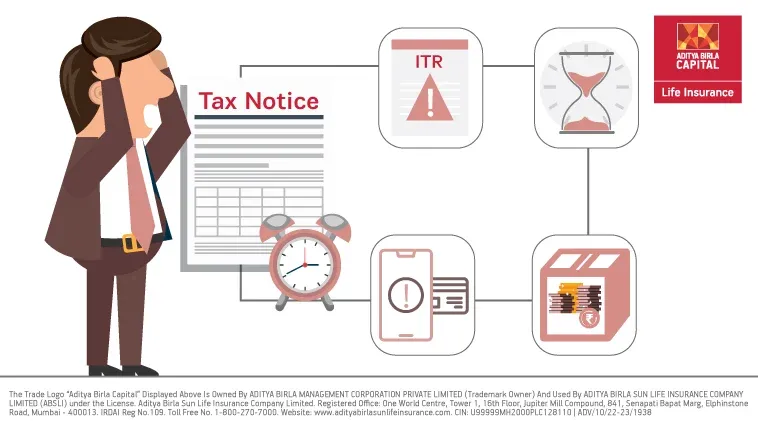
 Table of Contents
What Should I Do if I Get an Income Tax Notice?
Maintain your calm and double-check the information. Recognise the reason for the notice's issue and take the relevant measures. Please keep in mind that you should never disregard an IT notification. If you are unsure about resolving the situation on your own, seek the assistance of a certified accountant or a tax specialist.
Additionally, keep the following considerations in mind to prevent legal ramifications:

Respond to the notification as soon as possible with all essential information and papers. If the whole set of documents is unavailable, you may seek more time but deliver what is currently accessible.
If there is a delay in submitting the papers, contact the IT department. This will keep them informed and demonstrate that you plan to comply with the evaluating officer's standards.
The department does not always provide the document list for random review. In this instance, you must gather and submit any documentation that will support your response.
When you have completed all the papers and information, create a cover letter outlining your answer. Try to answer all of the questions in this letter, and provide a detailed list of the documents you are delivering with your response.
Make a copy of the materials you're submitting. This is for your records if you ask for another enquiry after you submit your original answer.
When sending a response, you must attempt to get an acknowledgement from the department saying that the information has been received. If there is a subsequent disagreement, this will serve as evidence.
Essential Things to Keep in Mind
Respond on time
Always respond to the income tax department on time, even if you cannot gather the necessary information. You may also seek more time to prepare the same. It would imply that you are truthful and willing to cooperate with the authorities.
Keep the envelope
If you get a notification from the tax department, save it. The envelope carries a speed post number, which may serve as proof of delivery to you and when it was delivered.
Get expert Help
To fix the problem, you may seek the services of a professional. If the sensitivity of the notice is high, it is recommended that you have a Chartered Accountant represent you.
How Much Helpful You Found This Article?

Rated by 0 reader
/ 5 ( reviews )
Not helpful
Somewhat helpfull
Helpful
Good
Best

Thank you for your feeback
FAQs Top Reasons for Receiving Income Tax Notice
If you get an income tax notice, do not be alarmed; reply to the notification and supply the papers and information requested by the department. File a corrected return and pay any taxes owed within the timeframe given. It is preferable to delegate the response to a tax specialist.
To see whether there is a tax notification, do the following steps: First, access the income tax portal by providing your user ID (PAN Card), date of birth, password, and captcha code. Select WORKLIST from the top menu. Select the "For Your Action" option. If you have any outstanding notifications against you, they will be displayed there.
Under section 142(3) of the Income Tax Act of 1961, scrutiny assessment, also known as a detailed assessment, is addressed. In this assessment, the taxpayer only gets a warning if there is any uncertainty about the authentication of income or if they know about income hiding. This examination is carried out to validate the correctness of numerous claims, deductions, and so on submitted by the taxpayer when submitting income tax returns.
The following methods are available for checking the tax order online: Access the e-Filing Portal. Navigate to the 'My Account menu and choose 'Service Request." Then click 'New Request' and choose the 'Intimation under section 143(1), 14/16(1)/35' Request category. Then press the "Submit" button.
Suppose you do not react to the notification within 30 days of receiving it. In that case, the income tax return will be filed automatically after making the appropriate modifications under section 143(1)(a) of the Income Tax Act of 1961.
After 30 days, there would be no more possibilities to make changes.
Visit the income tax filing website and download the appropriate Income tax return form for the current tax year. Then, from the alternatives provided, choose in response to a notification under section 139(9) when the initial return submitted was faulty. Fill in the reference and acknowledgement numbers, and then complete the form with corrections.
A corporation or firm is required to submit an income tax return. On the other hand, individuals, HUFs, and associations of people are obliged to submit an income tax return if their income exceeds the basic exemption level of Rs 5 lakhs. Senior persons and super senior citizens have various income limits.
The overdue tax demand may be paid online using the following link: Tax payments may be done online using the e-taxes website. Make the payment, referencing head '400'. Challan Status: The website allows you to check the status of your payment Challan. These payments will also appear on Form 26 AS statement.
You may verify the status of a tax demand by following these steps: Access the 'e-Filing' Portal. Navigate to the e-File menu and choose 'Response to Outstanding Demand.' This page will show all outstanding requests. Under the 'Response' column, click the 'View' hyperlink.
Income tax returns can be filed after paying all taxes and dues, such as interest. An ITR filed without paying taxes is referred to as a defective return under Section 139(9). In that case, the assessment officer will allow you to remove your defect within 15 days of receiving notice under Section 139(9), which means you can pay taxes and file a return in response to Section 139(9).
Show All
Hide
Buy ₹1 Crore Term Insurance @ ₹575/month1
ABSLI DigiShield Plan
Life cover up to 100 years of age.

Joint Cover Option

Inbuilt Terminal Illness Benefit

Tax Benefit^

Return of Premium Option~
Life Cover
₹1 crore
Premium:
₹542/month1
 BUY ONLINE
Recently Added Article

Most Popular Calculator


ABSLI Salaried Term Plan (UIN:109N141V01) is a non-linked non-participating individual pure risk premium life insurance plan; upon Policyholder’s selection of Plan Option 2 (Life Cover with ROP) this product shall be a non-linked non-participating individual savings life insurance plan.
1LI Age 21, Male, Non Smoker, Option 1: Life Cover, PPT: Regular Pay, SA: ₹ 1 Cr., PT: 10 years, Premium paying term: 10 years, Annual Premium: ₹ 5900/- ( which is ₹ 491.66/month) Premium exclusive of GST. On death, 1 Cr SA is paid and the policy terminates.
ADV/9/22-23/1581

